
Share Via:
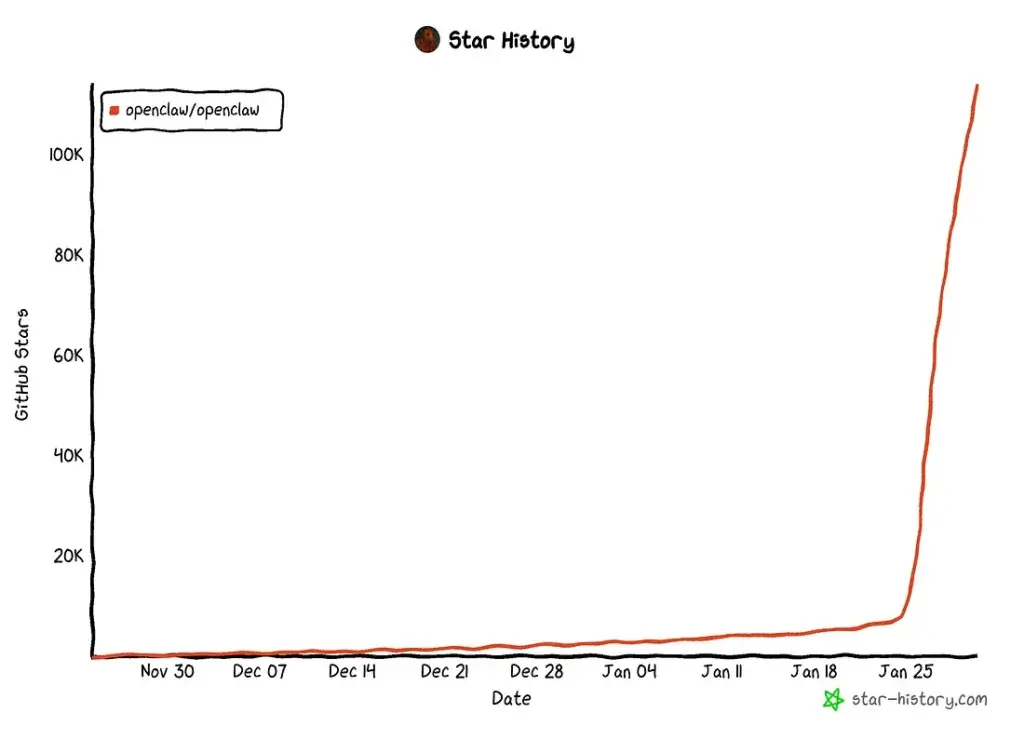
In six days, an open-source AI agent accumulated 103,000 GitHub stars—the fastest software growth in the platform’s history—triggered Mac Mini M4 shortages across retail channels, and moved Cloudflare’s stock price 20%. The project was renamed three times under legal pressure, spawned a $16M crypto scam, and leaked 200+ corporate secrets including healthcare documentation and production Kubernetes credentials. Google Cloud’s VP of Security Engineering publicly warned against deploying it.
103,000 developers starred it anyway.
This isn’t a product story. It’s a preference revelation under conditions of uncertainty.
What Actually Happened
Peter Steinberger—Austrian developer who previously sold PSPDFKit to Insight Partners for ~$100M—launched OpenClaw (originally “Clawdbot”) in late 2025 as a self-hosted AI assistant. Unlike cloud-based alternatives, it runs on user-owned hardware and integrates across messaging platforms: WhatsApp, Telegram, Discord, Slack, iMessage, Signal.
The growth trajectory:
- January 24: Daily GitHub forks jump from 50 to 3,000
- January 25: 9,000 stars in 24 hours, endorsements from Andrej Karpathy and David Sacks
- January 27: 60,000 stars, Anthropic forces trademark-based rename from “Clawdbot” to “Moltbot”
- January 28-29: +17,830 stars in single 24-hour period (GitHub record)
- January 30: Renamed again to “OpenClaw,” crosses 103,000 stars
During the first rename transition, crypto scammers exploited a 10-second window to hijack the old Twitter handle and launch a fake $CLAWD token. It reached $16M market cap before Steinberger’s public disavowal caused a 90% collapse.
Security researchers found hundreds of exposed control panels via Shodan scans. GitGuardian detected 181 unique leaked secrets in user repositories, including a Notion token granting full access to a healthcare company’s corporate documentation and a Kubernetes certificate providing privileged access to a fintech company’s production cluster.
Meanwhile, Mac Mini M4 units sold out globally as users bought dedicated hardware specifically to host autonomous agents.
The Sovereignty Preference Proof
The adoption pattern reveals actual values under conditions of choice.
Users deploying OpenClaw are accepting:
Technical complexity: Node.js installation, Docker configuration, API authentication, webhook setup, skill marketplace integration. The onboarding wizard helps but deployment remains non-trivial.
Security exposure: The project’s FAQ states plainly: “There is no ‘perfectly secure’ setup.” OpenClaw requires terminal access, stores credentials in plaintext by default, and operates with minimal sandboxing. Demonstrated prompt injection attacks show malicious emails can trigger unauthorized actions within minutes.
Hardware investment: $500-600 Mac Mini purchases, dedicated server costs, or $5-150/month cloud hosting—substantially more than $20/month ChatGPT subscriptions.
Maintenance burden: Beta software with breaking changes, community-driven development with 321 contributors, skill marketplace with no moderation process.
Legal uncertainty: Three name changes in six days, ongoing trademark concerns, unclear liability boundaries for autonomous agent actions.
To gain:
Data locality: Conversations, memory, and execution logs remain on user-controlled infrastructure rather than vendor servers.
Platform independence: Single agent instance works across every major messaging platform simultaneously. No vendor lock-in to specific ecosystem.
Capability ceiling removal: Full system access, terminal command execution, browser automation, file system control. Safety rails can be disabled entirely.
Agency preservation: User owns the infrastructure, controls the data, determines the capabilities, sets the boundaries.
The “convenience always wins” thesis fails empirically when capability differential is significant enough. High-agency individuals choose sovereignty over ease at scale.
The Execution Layer Commoditization
OpenClaw demonstrates a predictable infrastructure pattern: execution capabilities that seem like competitive advantages become table stakes when open-source implementations reach functional parity.
Capabilities now commoditized:
- Persistent memory across sessions and platforms
- Proactive monitoring and autonomous notification
- Multi-platform integration (10+ messaging services)
- System-level access and command execution
- Browser automation and web interaction
- File management and organization
- Calendar and email integration
- Multi-agent coordination and skill routing
With 321 contributors extending the codebase and 14,400+ forks creating variants, the execution infrastructure improves faster than enterprise development cycles can match.
The competitive stack separates into layers:
────────────────────
│ORIENTATION LAYER ← Value capture│
│(Frameworks for what to automate)← Non-commoditized │
├────────────────────┤
│EXECUTION LAYER ← Commoditized
│(Task automation, integration ← OpenClaw operates here │
├────────────────────┤
│INFRASTRUCTURE LAYER ← Volume monetization │
│(Compute, networking, storage) ← Cloudflare positioned here │
────────────────────
Infrastructure providers benefit regardless of who wins execution. Cloudflare’s 20% stock movement reflects positioning as the networking layer for distributed autonomous agents. The company responded by launching “Moltworker”—a managed hosting service that removes setup complexity while maintaining the local-execution model.
The execution layer compresses toward zero margin. Value migrates to layers above and below.
The Fork Made Visible
Two architecturally incompatible approaches to human-AI integration have been developing in parallel:
Path A (Absorption):
Cloud-hosted AI, vendor control, subscription models, platform ecosystems, safety-first design, users as products, convenience over capability, centralized infrastructure, compliance frameworks, managed risk.
Representatives: ChatGPT, Claude Pro, Gemini, Copilot, Alexa, Siri, Google Assistant.
Path B (Sovereign Integration):
Self-hosted AI, user control, pay-per-inference, open integration, capability-first design, users as sovereigns, control over convenience, distributed infrastructure, personal responsibility, managed complexity.
Representatives: OpenClaw, local LLMs, self-hosted infrastructure, open-source tooling.
Until January 2026, Path B was primarily theoretical—developer discussions about what should exist, projects with potential but limited traction.
OpenClaw proved Path B viable at scale. Not as concept but as deployed reality with measurable adoption.
103,000 GitHub stars represent 103,000 explicit votes for sovereign infrastructure over managed convenience. The Mac Mini shortages represent capital commitment to the preference. The 8,900-member Discord community represents sustained engagement beyond initial enthusiasm.
Anthropic’s response is instructive: forced rename despite OpenClaw driving Claude API subscription revenue. Many users configured OpenClaw to use Claude as the reasoning engine—direct revenue to Anthropic, ecosystem validation, use case demonstration. Yet Anthropic chose legal enforcement over ecosystem benefit.
That pattern—legal pressure instead of integration—reveals defensive positioning. When open-source execution infrastructure proves viable, strategies built on controlling the execution layer become vulnerable.
The Coherence Gap Emerges
Users deploying OpenClaw experience a predictable developmental sequence:
Phase 1 (Days 1-7): Capability deployment. Sudden 10x increase in execution capacity. Tasks that previously required hours happen automatically. Email management, calendar coordination, file organization, research compilation—all delegated to autonomous processes.
Phase 2 (Days 7-14): Efficiency gains. Measurable productivity improvements. More tasks completed per unit time. Workflows accelerate. The agent handles increasingly complex multi-step operations without supervision.
Phase 3 (Days 14-21): Disorientation. The bottleneck shifts. Execution is no longer the constraint. The question becomes: what’s worth automating? With capability to delegate nearly anything, determining what actually matters becomes non-trivial.
Phase 4 (Days 21+): Framework search. Users recognize need for decision-making infrastructure above the execution layer. Not productivity tools (those optimize pattern execution). Something that helps identify which patterns serve development versus distraction.
Automation executes patterns faster. It doesn’t determine which patterns matter.
OpenClaw can clear inbox to zero. It cannot assess whether inbox zero serves actual development or creates illusion of productivity.
It can schedule fifteen meetings. It cannot evaluate whether those meetings advance meaningful work or simply fill calendar space.
It can execute one hundred tasks flawlessly. It cannot determine whether those were the right one hundred tasks.
Execution layer: solved.
Orientation layer: open territory.
Forward Implications
Near-term (Q1-Q2 2026):
Multiple products will emerge claiming to provide “AI agent guidance” or “automation alignment.” Most will be productivity frameworks—task prioritization systems, goal tracking interfaces, efficiency metrics, focus timers. These optimize execution of existing patterns rather than questioning which patterns warrant execution.
Enterprise solutions are already forming. “OpenClaw for Business” offerings with compliance guarantees, managed hosting, security frameworks, and higher pricing justified by removing complexity. This captures institutional markets where individual sovereignty conflicts with organizational control requirements.
Security incidents are inevitable. Misconfigured public instances will be compromised. Prompt injection attacks will succeed against production deployments. Media amplification will follow. Regulatory attention will increase. Enterprise solutions will use incidents to justify managed approaches.
Medium-term (Q2-Q4 2026):
The market bifurcates cleanly:
Path A Ecosystem: Cloud agents, enterprise control, managed risk, compliance-first design, higher prices, lower capability ceiling, corporate and institutional adoption.
Path B Ecosystem: Local agents, user sovereignty, managed complexity, capability-first design, lower infrastructure cost, higher technical requirement, high-agency individuals and small teams.
Both paths are viable. Both serve distinct populations with incompatible values. The bifurcation is structural, not transitional.
Infrastructure consolidation occurs. Cloudflare, DigitalOcean, and specialized providers compete for agent hosting and networking. Hardware optimization for agent workloads becomes product category. Networking protocols for agent-to-agent communication standardize.
The orientation layer market forms. Products that address the coherence gap—determining what automation should serve—become differentiated category. This separates from productivity tools through different ontological framing: not “execute faster” but “navigate complexity.”
Long-term (2027+):
Asymmetries emerge between individuals with sophisticated orientation frameworks and larger organizations without them. Small, coherent teams with well-architected automation outperform large, centralized operations with powerful but directionless execution infrastructure.
The premium shifts from capability to coherence. As execution capacity becomes commodity, the bottleneck becomes human capacity to direct that execution meaningfully. Markets reward not those with most powerful automation but those who automate the right things.
What OpenClaw Proved
Execution infrastructure commoditizes when open-source implementations reach functional parity with closed alternatives. Users with sufficient agency demonstrably choose sovereignty over convenience when capability differential justifies complexity. Path B architecture is viable at scale, not as future speculation but as operational reality measurable in adoption metrics and capital deployment.
What OpenClaw Didn’t Prove
How humans maintain coherence while wielding 10x execution capacity. What frameworks prevent automation from serving unconscious acceleration rather than conscious development. Which structures enable navigation when execution is no longer the constraint.
The execution layer is solved. The orientation question remains open.
103,000 developers have deployed the capability. What happens next determines whether autonomous agents amplify human agency or erode it.
Share Via: